ISSUE #4
Welcome to our summer news round-up!
NLISN MEMBERSHIP
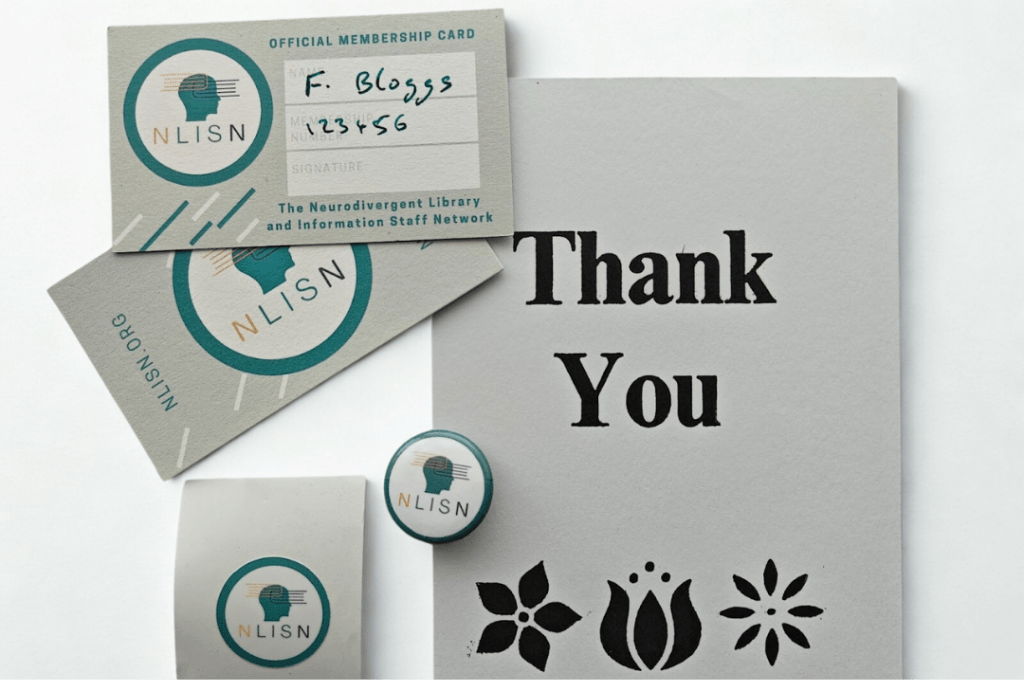
We’ve been asked many times “how do we join NLISN”, and while formal membership is not required, we thought we’d introduce some options for those who’d like to receive updates and support our work:
A Free (personal) or Paid (personal) membership includes:
- Discount on any charged-for events we run
- Invitation to our annual general meeting
- Optional sign-up to our JISCmail list OR just the quarterly Newsletter
- Optional follow on Bluesky
- Optional access to our Discord server (currently being trialled)
The paid (personal) level will also get you a small membership pack in the post (UK only). The exact contents of the membership pack may be subject to future change, but will always include a membership card, plus other materials.
A paid membership option for Allies is also available, and we hope to introduce an option for organisations in the future.
Find out more, and sign-up here!
THE NLISN ANNUAL REPORT
Our first annual report is now available to download and read!
The report gives an overview of our events, outputs, and achievements over the last year, including our receipt of the 2024 Lynne Mackie Accessibility Award from CILIP’s Disability Network.
Plus find out about our upcoming plans for further research and case studies. We’ll be aiming to gather statistics on neurodivergent representation in the library and information professions in the UK and Ireland.
Stay tuned!
EVENT NEWS
Upcoming Event: “You deserve to take care of yourself”: The Workplace Experiences of Neurodivergent Librarians
Tuesday 2nd September, 15:30-16:30 BST | Online
Dr Christine M. Moeller will be presenting findings from an IMLS-funded research project focused on the workplace experiences of neurodivergent librarians. She’ll discuss the embodied knowledge that neurodivergent librarians enact while navigating barriers and opportunities in their workplace and profession:
Although libraries are beginning to address neurodiversity, such efforts are primarily focused on patrons and fail to consider neurodivergent librarians. To navigate workplace barriers, neurodivergent librarians use their lived experience to develop and apply strategies that help them minimize some inaccessible aspects of their workplaces. These strategies represent forms of embodied knowledge. Embodied knowledge includes tactics like strategic disclosure and masking, but also knowledge of tools and other strategies, such as social critique, that can be deployed in various ways to navigate the workplace barriers and challenges that neurodivergent librarians encounter. During this session, participants will learn about these strategies and tactics for navigating ableist workplaces.
This is a free event, however you will need to book a place in order to receive the event link and see further information.
Previous Event, Slides Now Available: Equality, diversity, and inclusion in the research library: looking at recruitment practices
Slides are now available from our previous event, featuing Dr. Christina Kamposiori, Programme Officer at Research Libraries UK (RLUK) presenting on recruitment practices from the perspective of equality, diversity, and inclusion in the research library.
This talk is based on the results of a piece of research conducted recently by RLUK, which aimed to showcase how RLUK institutions work towards developing more inclusive practices in workforce recruitment and retention. The results of this research enabled the development of a better understanding of the steps that RLUK research libraries currently take to establish new processes or review existing practices with the aim of becoming more inclusive and diverse places. This presentation will share key findings and examples of best practice that emerged from the research.
Access Dr. Kamposiori’s slides here.
Call for Speakers: Adjustments in the Workplace for Neurodivergent Library and Information Staff
NLISN are organising an in-person event at Leeds Beckett University on Mon 6th October 2025 on the topic of Adjustments in the Workplace for neurodivergent library and information staff.
We are looking for speakers who would like to deliver either 15-min talks, 30-min talks, panel discussions, or a 1-hr interactive workshop on a topic of your choosing connected to adjustments in the workplace. For the 15-min or 30-min talks you can either present in-person, or provide a pre-recorded talk. Questions would still take place in person.
Suggested topics could be:
- Adjustments and accommodations as a new member of staff e.g. your experiences before starting, inductions, lifecycle throughout the workplace
- Experiences as someone newly diagnosed whilst already in a workplace and needing new adjustments implemented
- Identifying adjustments you need and what/how to ask for these as someone newly diagnosed
- Experiences related to communicating with colleagues about adjustments – line managers, peers and other colleagues, staff you manage yourself in relation to your own adjustments
- Inductions/on-boarding – your experience as someone who has designed these and how you incorporated adjustments into that process
- Dealing with occupational health, Access to Work etc.
- Support networks and union support for getting adjustments implemented – either speaking to or being part of yourself and supporting others
Please submit your proposals using our NLISN Adjustments Call for Speakers Google Form by Friday 22nd August, and expect to hear back from us by Monday 1st September. Speakers would be eligible for a free ticket to the event.
If you do not work directly in a library or information role we would still welcome your proposals as long as the content is transferable to a library or information role or setting and relevant to library and information staff.
We are keen to attract speakers from a range of different library and information role settings and with different job roles and perspectives so please do share this with colleagues you think may be interested who may have missed this email.
Coffee Catch-Ups
Our Online Coffee Catch-Ups run every month and are an opportunity for you to meet with other members of the network online in an informal space with no agendas or set topics. We aim to create a space where we can get to know each other and have informal and supportive discussions.
Our next catch-up will be on Thurs 4th Sept, 10:00am-11:00am.
The Coffee Catch Ups will be run via Teams and will be facilitated by a member of the NLISN committee.
Please feel free to accept the Team meeting invitations even if you are not sure you will be able to attend to ensure they are in your calendar. Individual attendance beyond total number of people will not be monitored at all, so accepting them does not mean you are obliged to attend.
External Event: NeuroGLAM 2025
Friday 22nd September, 17:00-21:00 | Online
The members of Neuro-GLAM-orous Canada invite you to participate in their third annual free online conference.
The theme of this year’s conference is neurodiversity, GLAM, fascism, and its discontents, and features presentations and panels including:
- I, the Mask: Navigating Work Post-Disclosure (Elizabeth Cardoso Fernandes)
- Navigating Environmental Mismatch as a Neurodiverse Academic Librarian (Priscilla Carmini)
- Archivists and Librarians Managing Disabilities and Chronic Illnesses in the Pandemic Era: Navigating the Workplace Before COVID-19, During Lockdown, and After the Return to In-person Work (Hilary Barlow)
RESOURCES ROUND-UP
Our resources collection gathers together articles, research, reports, podcasts, websites, organisations and more that we believe will be relevant and helpful to neurodivergent library staff. Here we higlight some recent additions:
While disclosure can provide access to tailored accommodations, disclosure should not be the sole pathway to support neurodivergent employees. Many inclusive practices, such as flexible scheduling or quiet workplaces, could be made universally available, benefiting all employees regardless of disclosure.
As open neurodiversity becomes more accepted at work, neurodivergent leaders are unmasking to challenge stereotypes and redefine leadership.
The findings of this study highlight the positive impact a diagnosis can have on autistic adults’ employment and career path. The study also identified persisting workplace barriers which continued to impact autistic adults after their diagnosis.
This study investigates the workplace experiences of 51 ethnic minority professionals who self-identify as neurodivergent, focusing specifically on the impact of intersectional stereotyping within organizations in the United Kingdom and United States. The research explores how neurodivergent employees’ racial or ethnic minority backgrounds influence their self-perceptions and experiences regarding prevailing stereotypes in professional environments.
This research seeks to explore how neurodivergent individuals’ experiences during selection and assessment shape their perceptions of an organization’s diversity climate and organizational attractiveness. Findings suggest that prioritizing an inclusive organizational climate becomes a privilege afforded to those with more employment options, highlighting the systemic exclusion that still faces neurodivergent candidates in organisations today.
Christine M. Moeller (2025). Librarianship’s marginalisation of neurodivergent librarians. CALC Conference. YouTube.
While libraries are increasingly implementing practices and services designed to serve neurodivergent patrons, such efforts have not yet extended to neurodivergent librarians. Did you know that at least 20% of library workers are neurodivergent? Did you know that most library workplaces are not yet neuroinclusive, even though librarianship is a field that appeals to neurodivergent people? Come learn more about neurodiversity employment in libraries, informed by findings from an IMLS-funded research project that aims to improve the capacity of U.S. libraries to recruit, onboard, retain, and advance neurodivergent librarians.
This session will highlight the voices of neurodivergent librarians and their journey of negotiating identity and deploying embodied knowledge to navigate the barriers and opportunities they encounter in their workplace and profession.
The Neurodiverse Museum strives to change the way museums approach their work with and for neurodivergent people. Our organisation works primarily online to support museums and museum professionals to develop their practice across three key identified areas of workforce, audiences and collections.
We aim to shift the dialogue and provision from deficit, person first, exclusionary models, to presumed competence, identify first, inclusionary models with #ActuallyAustitic and neurodivergent voice at its heart.
Over the coming months we will be sharing research, case studies, and a range of supporting provision to ensure neurodiversity is viewed and supported in-line with lived experience.
The Thinking Person’s Guide to Autism Newsletter
Thinking Person’s Guide to Autism Newsletter (TPGA) is a newly-launched weekly roundup of autism-related science, news, and culture that you won’t find anywhere else. This information is curated by the TPGA editorial team, with autistic representation, and written by Dr. Emily Willingham.
 Neurodivergent Library and Information Staff Network
Leave a comment